Introduction
Discover the sustainability benefits of carpet tiles compared to alternative flooring options. Explore how sustainable carpet tiles can reduce waste, lower emissions, and support circular economy strategies—featuring Lifespace Flooring’s eco-innovations and take-back scheme.
In an era where environmental impact, resource conservation, and circular design matter more than ever, choosing flooring isn’t just an aesthetic or functional decision — it’s part of your sustainability footprint. One flooring choice gaining growing attention is sustainable carpet tiles. Compared with traditional soft flooring and hard surface alternatives, carpet tiles offer unique advantages in terms of waste reduction, reuse potential, reduced embodied carbon, ease of replacement, and circularity.
In this blog, we’ll examine the sustainability benefits of carpet tiles versus other flooring options, explore real-world examples (especially from Lifespace Flooring), and break down the environmental, economic, and operational arguments in favour of sustainable carpet tiles.
Why Flooring Choices Matter for Sustainability
Before we dive into carpet tiles, it’s worth framing why flooring choices are so critical in sustainable buildings:
- Material and embodied carbon: Flooring materials require extraction, manufacturing, transport, installation, and maintenance. The embodied carbon and environmental cost of those life-cycle stages can be significant.
- Longevity and durability: A floor that must be replaced entirely every decade generates more waste and requires repeated resource inputs.
- Maintenance, cleaning, and energy usage: Some flooring types demand frequent cleaning or high energy or chemical inputs (e.g. waxing, sealing).
- End-of-life and waste: If flooring ends up in landfill, all embedded energy and materials are wasted—and worse, may degrade or release harmful substances.
- Upgradability or repairability: Floors that allow localised replacement or modular swapping reduce waste and disruption.
Thus, optimal sustainable flooring is one that minimises upfront environmental impact, maximises lifespan and adaptability, and supports circular end-of-life flows. Sustainable carpet tiles often score well in those dimensions.
What Are Sustainable Carpet Tiles?
The term sustainable carpet tiles refers to modular carpet flooring (tiles rather than broadloom carpet) manufactured, installed, maintained, and disposed of in ways that reduce environmental impact and promote circular lifecycle management.
Key traits of sustainable carpet tiles include:
- Use of recycled or reclaimed materials (e.g. recycled yarns, recycled backing, reclaimed fillers).
- Production in facilities with carbon-neutral operations or low-carbon inputs.
- Low-VOC emissions and chemical safety (e.g. compliance with REACH regulations in the EU).
- Modular tile format so that individual tiles can be replaced rather than replacing the entire floor.
- A take-back or recycling scheme to ensure that end-of-life tiles are collected, refurbished, or recycled, rather than sent to landfill.
- Manufacturing proximity to reduce transport emissions or supply chain carbon.
We are a strong example of this, our tiles are fully REACH compliant, manufactured in a carbon-neutral facility, and backed by a take-back scheme to ensure end-of-life responsibility.
Our design ranges have backings that incorporate 100% recycled calcium carbonate filler, reclaimed from industrial waste streams like glass and ceramics manufacture, making the total backing 75% recycled.
Thus, when we say “sustainable carpet tiles,” we are not just speaking of the modular tile format—but of a full lifecycle commitment, as manifested by manufacturers such as us.
Comparing Flooring Options: Pros & Cons
To understand the advantages of sustainable carpet tiles, we should compare them to the main alternative flooring types:
- Broadloom carpet (wall-to-wall soft carpet rolls)
- Hard surface floors — such as wood, laminate, vinyl, engineered wood, ceramic/porcelain tile, polished concrete
- Resilient flooring (sheet vinyl, linoleum, rubber)
We’ll compare across criteria such as embodied carbon, waste potential, replacement ease, maintenance, end-of-life, indoor air quality, and adaptability.
Broadloom Carpet vs Sustainable Carpet Tiles
Embodied impact and material use:
Broadloom carpet typically comes in large rolls and may involve heavy backing systems, more waste trimming, and more continuous adhesives. In contrast, sustainable carpet tiles (especially from committed producers) may use lower-impact materials with recycled content and reduce waste by modular installation patterns.
Waste and replacement:
If a part of a roll carpet is damaged (stain, burn, rip), it’s often necessary to patch or replace a large area, potentially causing mismatches or waste. With sustainable carpet tiles, individual tiles can be removed and replaced. This means that over the life of the floor, many fewer materials are scrapped.
Installation and adhesives:
Broadloom carpet often uses full-surface adhesive, which complicates removal and reinstallation, and often leaves the substrate damaged. Tiles may use tackifier dots, loose-lay systems, or adhesive only periphery, making removal easier and less destructive.
End-of-life and reuse:
Tile systems facilitate reuse or repurposing. Companies like us support a Commercial Carpet Tile Take-Back Scheme, meaning they will collect used tiles and recycle or reprocess them rather than send them to landfill. Broadloom carpet rarely offers such circular end-of-life pathways. You can download our sustainability brochure and view more details on our carpet tile take back scheme here.
Maintenance and replacement over time:
If part of a broadloom carpet gets soiled beyond recovery, you risk having to replace large contiguous areas. With tiles, localised replacement is easier. This improves life expectancy and reduces total material consumption.
Thus, sustainable carpet tiles tend to outperform broadloom carpet on sustainable metrics when properly specified and managed.
Hard Surface Floors (Wood, Laminate, Tile, Concrete)
Hard flooring options are often selected for durability and aesthetics. But how do they compare on sustainability dimensions?
Embodied carbon and resource extraction:
Many hard surface floors rely on virgin materials: hardwoods (harvested trees), porcelain or ceramic (clay and energy-intensive firing), engineered composites, or stone quarrying. The embodied energy can be high.
By contrast, sustainable carpet tiles can incorporate recycled or reclaimed inputs, reducing the net resource burden.
Wear and finish reapplication:
Wood or engineered wood may require sanding, staining, or recoating periodically, which uses materials, energy, and chemicals. Tile or stone may remain long, but if damaged, tile replacements may be limited by availability or matching. With carpet tiles, wear is distributed, and worn tiles can be swapped without major interruption.
Thermal and acoustic benefits:
A carpet tile floor typically provides more acoustic absorption and thermal insulation than a bare hard surface, reducing heating/cooling loads and improving indoor acoustic comfort. These performance gains translate into operational energy savings and thus indirect environmental benefits.
Adaptability and flexibility:
Hard floors often require total removal and replacement for upgrades or rewiring. In contrast, sustainable carpet tiles allow easier access to subfloors, cabling, or underfloor systems, since individual tiles lift rather than requiring demolition.
End-of-life challenge:
Hard floors are often bonded with adhesives or mortars making removal destructive. Recycling or reclamation is rarely practiced at scale. Sustainable carpet tiles, again, fare better when backed by manufacturer take-back schemes. Lifespace’s policy of taking back used carpet tiles ensures zero landfill commitment and that materials are processed for reuse or recycling.
Resilient Flooring (Vinyl, Linoleum, Rubber)
Resilient floors such as sheet vinyl or linoleum offer durability and ease of cleaning, but have sustainability trade-offs.
Material sourcing and chemical content:
Traditional vinyl contains PVC and plasticisers. Even modern “phthalate-free” vinyl includes chemical complexity. Linoleum is more naturally derived (linseed oil, cork, wood flour), but still has adhesives and backing issues. Sustainable carpet tiles, especially REACH-compliant ones (as Lifespace’s are) guarantee chemical safety, eliminating many of the harmful substances often found in resilient flooring.
Maintenance, abrasion, and renewal:
Resilient floors may require frequent surface sealing or replacement if scratched. When they fail, large swathes often must be removed. Carpet tiles’ modular nature is advantageous.
Recycling and end-of-life:
Vinyl recycling infrastructure is limited, and many end-of-life sheets end up as waste or low-grade downcycling. In contrast, tile systems with take-back schemes can funnel materials back into manufacturing. There are schemes such as Recofloor and ReCover that support vinyl recycling, making the sustainability benefits higher in regards to end-of-life.
Key Sustainability Benefits of Sustainable Carpet Tiles
Let’s now isolate and enumerate the main sustainability benefits offered by sustainable carpet tiles—particularly when supported by responsible manufacturing and circular strategies.
1. Waste Minimisation and Modular Replacement
Because they are modular, carpet tiles allow selective replacement of damaged or worn tiles, instead of discarding large continuous flooring. Over time, this dramatically reduces material waste. If one tile is stained, you replace one tile—not the entire floor. This is one of the core operational benefits of sustainable carpet tiles.
2. Circular Economy & End-of-Life Take-Back
A truly sustainable carpet tile system is not just about modularity—it’s about closing the loop. Lifespace Flooring’s Commercial Carpet Tile Take-Back Scheme ensures that tiles at the end of their life are collected and recycled or repurposed, rather than dumped in landfill.
By taking responsibility for end-of-life disposal, Lifespace embodies the principle of product stewardship. That is a hallmark of authentic sustainable design and is one of the strongest differentiators of sustainable carpet tiles over many other floorings.
3. Use of Recycled and Reclaimed Materials
Sustainable carpet tiles can incorporate post-consumer or industrial waste filler, recycled yarns, reclaimed content in backing, and other low-impact components. For example, Lifespace uses 100% recycled calcium carbonate filler in some of its ranges, reclaimed from industrial processes like glass and ceramics manufacturing.
This reduces demand for virgin raw materials and diverts waste from landfill. Such content contributes to lower embodied carbon and resource strain.
4. Local Manufacturing & Reduced Transportation Carbon
Lifespace manufactures its sustainable commercial carpet tiles in the UK at a carbon-neutral facility, cutting transport emissions and supporting local supply chains.
By contrast, many flooring products—hardwood from distant forests, ceramic tiles shipped globally—incur large transportation carbon burdens. The proximity of production is a nontrivial sustainability advantage.
5. Carbon-Neutral Production & Operational Efficiency
Lifespace achieves carbon neutrality in its facility operations, and its production is ISO 9001 certified to reduce waste and inefficiency.
This means that emissions from energy, heating, manufacturing, and overhead are offset or minimised — reducing the environmental footprint of each square metre of sustainable carpet tiles.
6. Chemical Safety and Health
Lifespace’s sustainable carpet tiles are fully REACH compliant, meaning they meet high standards for chemical safety in the EU, avoiding harmful substances.
Low-VOC and non-toxic materials support healthier indoor environments—a major sustainability and health benefit over floorings that may off-gas or require aggressive cleaning chemicals.
7. Acoustic & Thermal Performance
Carpet tile systems inherently provide sound absorption and can improve thermal insulation relative to hard surfaces. These benefits can reduce building energy needs (heating, cooling) and contribute to occupant comfort.
8. Longevity and Lifecycle Cost Efficiency
Because of modular repair, durability, and support from take-back systems, floors using sustainable carpet tiles can often last longer or require fewer total resource inputs over their life than alternate systems. That long-term perspective is a core part of sustainable building economics.
9. Design Flexibility and Incremental Upgrades
Modular tiles allow partial replacement, redesign, or refurbishment without full reinstallation. You can update zones gradually, swap patterns, or refresh high-use areas independently. This adaptability reduces waste and cost compared to wholesale floor replacement.
Lifespace Flooring’s Sustainable Commercial Carpet Tiles
It’s instructive to dig deeper into Lifespace Flooring’s approach to illustrate how sustainable carpet tiles can be realized in practice.
Carbon-Neutral, UK-Based Manufacturing
Lifespace produces its sustainable commercial carpet tiles in the UK in a carbon-neutral facility. That means its operations—energy, heating, maintenance—are managed to offset or eliminate net emissions.
By localising manufacturing in the UK, Lifespace reduces transport emissions (for both inbound materials and outbound finished tiles) and strengthens supply chain resilience. That local production supports the case for sustainable carpet tiles as a lower-carbon floor option.
Recycled Filler in Backing
In three of its key ranges, Lifespace uses 100% recycled calcium carbonate filler (reclaimed from industrial waste) in the backing material. That’s a smart use of waste streams from other industries (glass, ceramics) to reduce virgin raw materials.
This design decision shows how sustainable carpet tiles can integrate circular inputs and reduce the carbon and resource footprint embedded in each tile.
REACH Compliance
Lifespace’s sustainable carpet tiles are fully REACH compliant, meaning they meet strict European chemical safety regulations and avoid harmful or restricted substances.
This compliance ensures that floors are safer for humans and the environment—important for green building certifications and occupant health.
Commercial Carpet Tile Take-Back Scheme
Perhaps the strongest sustainability commitment is the take-back program Lifespace offers: when tiles reach the end of usable life, Lifespace will take them back and ensure they are responsibly recycled or repurposed, committing to zero landfill disposal.
This scheme is a model for circular economy in flooring: rather than passing disposal burdens to the end user, the manufacturer retains responsibility, closing the loop.
Quality, Warranty, and Market Trust
Lifespace supports its sustainable carpet tiles with 15-year commercial warranties, ensuring that clients have confidence in durability.
Further, their sustainable credentials help in obtaining green certifications (BREEAM, Green Mark, etc.), appealing to clients for whom ESG is important.
By integrating low-impact materials, carbon-neutral production, modular design, and take-back responsibility, Lifespace’s sustainable carpet tiles deliver on both sustainability promise and market performance.
accreditations and certification
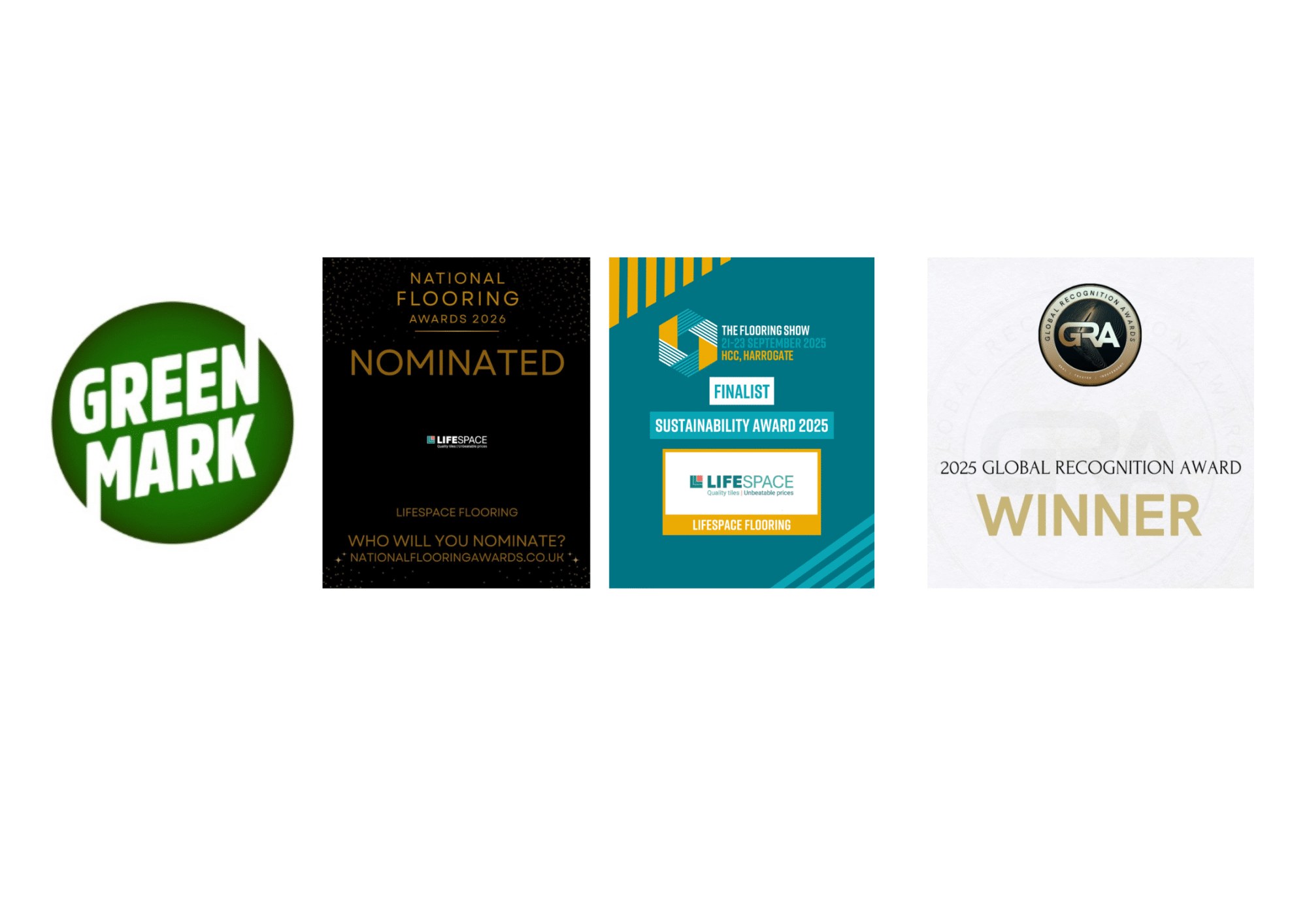
Lifespace is proud to have obtained Green Mark accreditation for our sustainability efforts, this further emphasises the impact we have on sustainability in the market.
In 2025 Lifespace was selected as a finalist for The Flooring Show‘s sustainability award alongside key players in the industry. Additionally, Lifespace received a Global Recognition Award for our operations which was also inclusive of our sustainable carpet tiles.
In 2026 we have already been shortlisted as a finalist in The National Flooring Awards again for our sustainability efforts.
Don’t just take our word for it, accreditations, certifications, and nominations speak for themselves.
Addressing Criticisms and Potential Limitations
No product or system is perfect. It’s fair to acknowledge some common critiques or challenges related to sustainable carpet tiles, and how they might be mitigated.
Challenge: Recycling Infrastructure
Although manufacturers like Lifespace offer take-back schemes, recycling infrastructure for carpet materials remains uneven globally. If end-users are far from collection centers, transport emissions and costs may deter participation.
Mitigation:
- Design local collection hubs or drop-off points – this is something the industry needs to work on as a whole.
- Organisations (including Lifespace) should consider offering credits or incentives to clients to return tiles.
- Use easily recyclable or separable materials in tiles (e.g. modular backing, minimal adhesives).
Challenge: Upfront Costs
More sustainable options sometimes incur higher upfront costs because of specialised materials, small-scale recycling streams, or carbon-neutral facility investments.
Mitigation:
- Highlight total lifecycle cost benefits (less waste, fewer replacements, lower maintenance).
- Use return-on-investment models that incorporate avoided landfill fees, disposal, and future replacement.
- Government incentives or green building subsidies can help offset initial premium.
Luckily Lifespace are proud to offer the sustainability element within our products but at considerably cheaper rates than other manufacturers, this is why we are slowly becoming one of the go to suppliers in the industry.
Challenge: Material Performance Trade-Offs
In aiming for recycled or alternative inputs, some tile variants may sacrifice performance (durability, stain resistance, dimensional stability).
Mitigation:
- Extensive material testing and quality control (e.g. ISO 9001 certification, as Lifespace uses) to ensure no compromise in durability.
- Use hybrid approaches: core structure uses recycled content, surface yarns remain high-performing materials.
- Clear warranties and performance guarantees to give clients confidence.
Challenge: Market Acceptance
Some clients or installers are more comfortable with traditional materials (broadloom, vinyl, hardwood).
Mitigation:
- Education and case studies showing long-term benefits and cost savings.
- Work with installation teams early to ensure they understand modular tile installation and removal (which is simpler in many cases). Email technical@lifespaceflooring.co.uk if you require any assistance on instillation. You can also view our instillation guide for more information.
- Emphasise sustainability credentials.
Despite these challenges, when well implemented, sustainable carpet tiles can offer among the strongest sustainable flooring solutions.
Comparative Table: Flooring Options vs Sustainable Carpet Tiles
| Criterion | Carpet Tiles | Broadloom Carpet | Hard Surface (wood, tile, concrete) | Resilient (vinyl, linoleum, rubber) |
|---|---|---|---|---|
| Waste & replaceability | Modular replacement, lower scrap | Patching difficult, higher waste | Damaged segments may require full area removal | Large sheets often must be replaced, high waste |
| End-of-life circularity | Take-back, recycling, reuse | Rare take-back, landfill | Limited recycling, adhesives hamper removal | Limited vinyl recycling, many end-of-life wastes, however, there are some schemes supporting this |
| Material inputs | Recycled content, reclaimed fillers | Primarily virgin inputs | Virgin timber, raw minerals, high embodied energy | PVC or petrochemical materials, synthetic ingredients |
| Installation disruption | Low, individual tiles removed | Moderate, full area | High, demolition & reinstallation | Moderate to high, adhesives removal |
| Maintenance and refurbishment | Localised replacement, low chemicals | Deep cleaning, occasional replacement | Recoating, refinishing, tile replacement | Surface coating, recoating, replacement |
| Indoor health & chemical safety | Low-VOC, REACH-compliant | Variable | Varnishes, sealers, adhesives may emit VOCs | PVC, plasticisers, adhesives may off-gas |
| Acoustic/thermal comfort | Good absorption, insulation | Moderate | Hard surfaces reflect sound, less insulation | Minimal absorption, colder feel |
| Transport & embodied carbon | Local production reduces emissions | May come from distant suppliers | Frequently imported or high-mass materials | Often manufactured far from use site usually not in the UK |
| Flexibility & upgrades | Modular redesign possible | Hard to work with modifications | High cost & disruption for changes | Moderate but may require full replacement |
| Lifecycle cost | Lower waste, repair savings | Higher replacement costs | Potentially long life but high remediation cost | Performance may degrade, needing replacement |
This table underscores how sustainable carpet tiles stack up favorably across many sustainability-relevant dimensions.
Practical Tips for Specifying Sustainable Carpet Tiles
If you’re a designer, architect, or procurement lead considering sustainable carpet tiles, here are some practical considerations and tips to ensure you maximise sustainability benefits:
- Check manufacturer credentials: Look for REACH compliance, ISO 9001 certification, carbon-neutral operations. Lifespace offers all of these for its sustainable carpet tiles.
- Ask about recycled content and filler materials: Tiles with reclaimed fillers (like recycled calcium carbonate) reduce virgin material demand. Lifespace uses 100% recycled filler in some ranges.
- Look for take-back or recycling schemes: A product is only truly sustainable if end-of-life is responsibly handled. Lifespace’s take-back scheme is a standout case.
- Specify modular adhesive or loose-lay systems: That helps future removal and reuse.
- Design for reuse zones: Use darker or more durable tile in high-traffic areas; reserve replaceable zones.
- Keep spare tiles: Always reserve a stock of unused tiles for future replacement or matching.
- Factor transport and logistics: Prefer suppliers with local production (preferably in the UK) to cut carbon.
- Document lifecycle assessments: Use LCA data to compare flooring choices on carbon, water, resource use.
- Engage installers early: Ensure they understand modular installation and minimal damage removal.
- Monitor performance and collect used tiles: During renovation, feed used tiles back into the take-back scheme.
By following these steps, you can ensure the sustainable carpet tiles you select deliver not just appearance and performance, but real environmental benefits.
Real-World Impacts & Numbers
While full lifecycle data will vary by product and region, some indicative impacts illustrate the potential of sustainable carpet tiles:
- Reduced landfill volume: Consider a large office re-fit: if broadloom carpet is replaced whole, tons of material may go to landfill. With modular tile replacement, waste volumes drop dramatically.
- Lower carbon footprint: Replacing with tile systems using recycled inputs and local manufacturing may cut embodied carbon per square metre by 20–40% relative to conventional carpet or imported hard flooring (depending on transport distances).
- Material circularity: With take-back, a large proportion of recovered materials (e.g. backing, fiber) can be reprocessed into new tiles or other products, keeping them in the industrial system rather than discarding them.
- Operational savings: Reduced maintenance, localised replacement, and potentially lower energy use (from insulation/thermal benefits) cumulatively can outrun the initial cost premium over a project’s lifetime.
- Waste diversion rates: Manufacturers with take-back programs (like Lifespace) can divert close to 100% of returned tiles from landfill.
These impacts translate to tangible sustainability gains in corporate, educational, healthcare, and commercial settings.
Addressing Objections: “But Hard Floors Last Longer”
One frequent objection is that hard floors (tile, stone, polished concrete) “last longer.” That’s partially true: many hard surfaces do endure for decades. But durability is only one metric; sustainability demands more holistic evaluation:
- Hard floors may require chemical sealing, use adhesives that inhibit recycling, and be difficult to remove without damage.
- Hard surfaces often lack built-in acoustic comfort, requiring extra carpeting, rugs, or sound management materials (adding material burden).
- If a section is damaged (crack, chip), matching tiles may no longer exist, forcing full area replacement.
- The inherent inflexibility of hard floors means future renovations demand demolition and reinstallation, much of which ends in waste.
By contrast, sustainable carpet tiles combine modular repair, evolving design flexibility, and closed-loop systems. So while “hard floor = eternally permanent” may hold superficially, in practice the modular, maintainable, and low-impact attributes of tile systems often yield superior sustainable outcomes over time.
Summary: Why Sustainable Carpet Tiles Often Win
Let’s summarise the chief reasons sustainable carpet tiles can outperform most alternative flooring choices in environmental, operational, and economic terms:
- Reduced material waste and selective replacement
- Circular take-back and recycling, avoiding landfill
- Use of recycled, reclaimed, or low-impact materials
- Lower transport carbon via local or carbon-neutral manufacture
- Chemical safety and healthier indoor environments
- Acoustic and thermal performance benefits
- Adaptability, flexibility, and upgrade potential
- Lifecycle cost savings when factoring in maintenance, waste, and replacement
- Strong warranty and market confidence (e.g. Lifespace 15-year warranties)
When you specify sustainable carpet tiles, and select responsible manufacturers like Lifespace Flooring with carbon-neutral facilities, REACH compliance, modular design, recycled fillers, and take-back schemes, you create a flooring strategy that supports circularity, resource efficiency, and long-term performance.
Conclusion
The choice of flooring is more than an aesthetic or functional decision—it’s a statement of commitment to environmental responsibility. Among flooring options, sustainable carpet tiles shine by virtue of modular reparability, resource-efficient materials, chemical safety, and circular end-of-life pathways.
Lifespace Flooring provides a real-world exemplar: carbon-neutral production, REACH compliance, recycled filler backings, and a take-back program all combine to deliver sustainable carpet tiles that are not just marketing but embodied practice.
By specifying modular installation, requiring take-back schemes, prioritising recycled inputs, and designing for longevity, architects and project teams can ensure that their floors contribute positively to their environmental goals. If you are rebuilding, re-fitting, or specifying new flooring, sustainable carpet tiles deserve serious consideration—and working with forward-thinking manufacturers such as Lifespace can help you deliver beautiful floors with a lighter footprint.
Frequently Asked Questions (FAQs)
Q1. What exactly defines a “sustainable carpet tile”?
A sustainable carpet tile is one that is manufactured, installed, maintained, and disposed of in an environmentally responsible and resource-efficient way. Key characteristics include modular construction, use of recycled or reclaimed materials, chemical safety (e.g. REACH compliance), carbon-neutral production, and an end-of-life take-back or recycling program.
Q2. Are sustainable carpet tiles more expensive than conventional flooring?
Lifespace want to bridge the gap between high quality sustainable carpet tiles and cost, therefore, all of our ranges are unbeatable on cost. Some other manufacturers and supplier products may carry a higher upfront cost due to specialised materials or circular infrastructure, but over the lifetime of the project they often yield savings through lower waste, fewer replacements, localized repairs, and reduced disposal fees. Lifecycle cost modelling typically shows strong value.
Q4. Can sustainable carpet tiles rival hard surface floors in durability?
Yes. When manufactured to high standards (e.g. ISO 9001 quality systems) and maintained properly, high-quality sustainable carpet tiles can endure heavy commercial use. Their modular repairability gives them an edge over hard flooring in real-world adaptability.
Q5. What is the Lifespace take-back scheme and how does it work?
Lifespace Flooring offers a Commercial Carpet Tile Take-Back Scheme: when tiles reach the end of their life, they are returned to Lifespace and either recycled or repurposed, with a goal of zero landfill. This ensures responsible disposal and supports circularity. For more information on this, you can contact our team here.
Q6. Does making carpet tiles recycled or using recycled filler affect their performance?
Not necessarily. With proper engineering and quality control, recycled or reclaimed fillers (e.g. recycled calcium carbonate) can deliver performance comparable to virgin materials. Lifespace uses recycled filler in three of its ranges without sacrificing tile stability or performance.
Q7. Can I achieve green building certification by using sustainable carpet tiles?
Yes. Using sustainable carpet tiles with materials transparency, low emissions, recycled content, and a take-back scheme can help gather points under BREEAM, LEED, WELL, or other rating systems—especially in categories related to materials, waste, indoor air quality, and lifecycle impact.
Q8. How do I specify sustainable carpet tiles for a large project?
Begin by requiring manufacturer credentials (REACH, ISO, carbon neutrality), modular installation systems, recycled inputs, and take-back commitments. Use lifecycle assessments and performance guarantees. Work with installers familiar with modular installation. Retain spare tiles for future replacement and incorporate layout strategies that maximise reuse potential.